Everyone negotiates base salary. Almost nobody negotiates equity correctly.
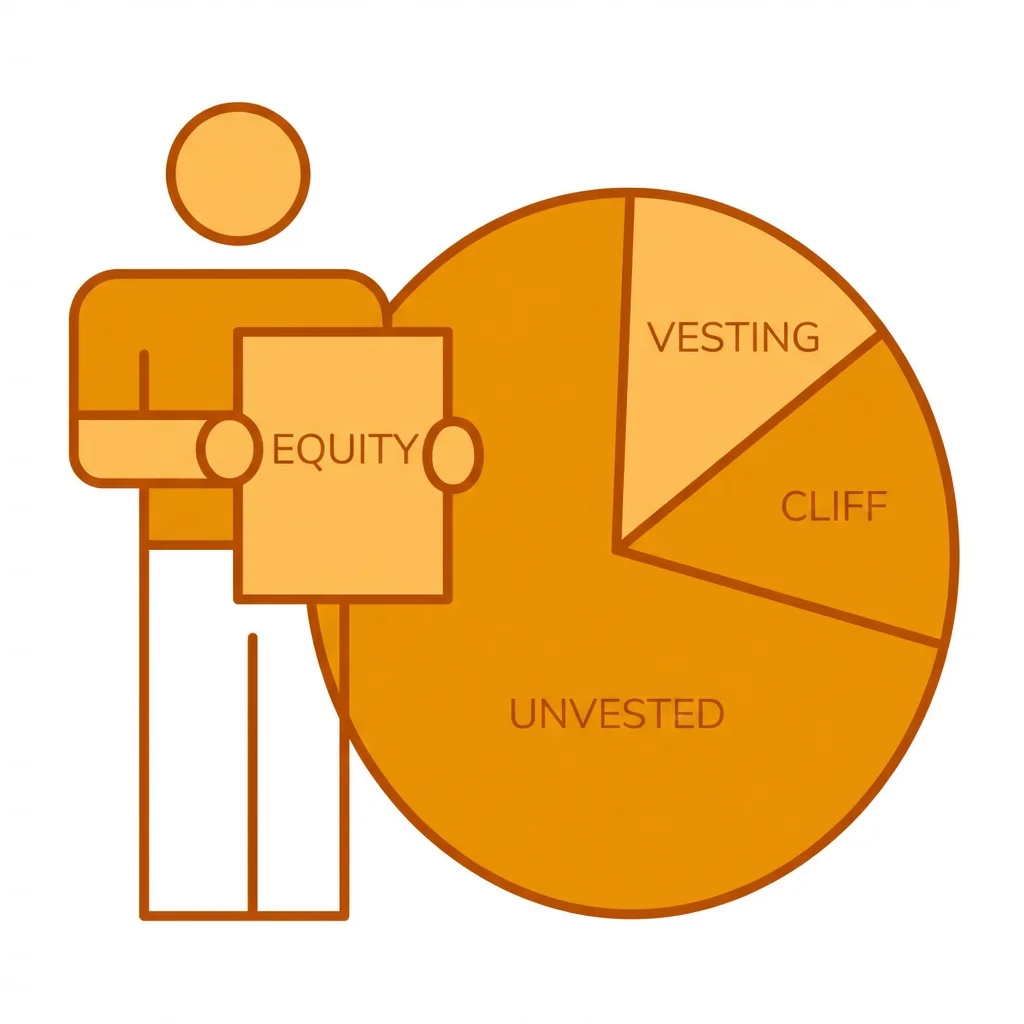
Equity can be worth more than three years of base salary. Or it can be worth exactly nothing. The difference is almost entirely in the details — and most candidates never ask about the details.
The problem isn't that people don't care about equity. It's that equity is designed to be confusing. The numbers sound big. The terms are arcane. And companies don't always volunteer the context that would help you evaluate what you're actually being offered.
Here's what you need to know: the four mistakes that cost people the most, the six questions that unlock the real picture, and the negotiation moves that actually work.
4 equity mistakes that cost people real money
Comparing shares without knowing the total cap table
10,000 shares sounds meaningful. It is meaningless without knowing: total shares outstanding, the current 409A valuation, and the last round's price per share. "10,000 shares in a company with 500M shares outstanding" is 0.002%. "10,000 shares in a company with 2M shares outstanding" is 0.5%. Same number, 250x different outcome.
Accepting a grant without understanding the vesting schedule
The standard is 4-year vesting with a 1-year cliff. That means if you leave before month 12, you get nothing. If you leave after month 13, you get roughly 25%. If the company's standard is 5-year vesting or a 2-year cliff — that changes the risk calculus significantly.
Not asking about the strike price vs. current valuation
ISO stock options have a strike price — what you pay per share when you exercise. If the strike price is $10 and the current 409A valuation is $10, your options are effectively worth $0 today (and you have to bet on future appreciation). If the strike price is $2 and current fair market value is $10, you have $8/share of immediate paper value.
Ignoring dilution
Every new funding round dilutes your stake. A company that does 3 more funding rounds between your grant date and exit could reduce your effective ownership by 50–60%. This doesn't make equity bad — it means "ownership percentage" at grant is not the same as "ownership percentage at exit."
6 questions that give you the real picture
Ask these during the offer stage — not before. These are due diligence questions, and the context of an offer gives you standing to ask all of them.
"What is the total number of shares outstanding, fully diluted?"
Lets you calculate actual ownership percentage, not just the share count.
"What was the price per share in the most recent 409A valuation?"
Gives you a proxy for current fair market value. Combined with your strike price, tells you your current paper gain (if any).
"What is the vesting schedule, and is there a cliff?"
Standard is 4-year/1-year cliff. Anything longer warrants negotiation or compensation elsewhere.
"What was the price per share in the last funding round, and at what valuation?"
Tells you what investors paid and what they believed the company was worth. Context for your equity's implied value.
"Is this an ISO or NSO grant, and what are the post-termination exercise windows?"
ISOs are tax-advantaged but expire faster after you leave (usually 90 days). NSOs are taxed as ordinary income at exercise but may have longer windows. Matters enormously if you're ever laid off.
"Has the company done any secondary sales or tender offers? Can employees participate?"
Some companies create liquidity events for employees before an IPO. If they have — you can potentially convert paper equity to cash. If they never have — your options remain illiquid until exit.
4 negotiation moves — with exact scripts
Ask for a larger initial grant
""I'm really excited about the role. On the equity side — based on the current 409A and my research on comparable grants at this stage — I was hoping to target [X] shares. Is there flexibility there?""
Use when: Always worth asking at offer stage. Most companies have a range per level and will grant the top of the range to candidates who ask.
Negotiate a refresh grant schedule
""Can we discuss a refresh grant schedule? I want to make sure we're aligned on long-term incentives as I grow into the role.""
Use when: Especially useful at senior levels where the initial grant is large — annual refreshes keep you aligned with the company's long-term success.
Trade base for equity (or vice versa)
""If base flexibility is limited, would you be open to making up the difference in equity? I'm comfortable with more upside risk if it's structured right.""
Use when: Early-stage startups with conviction. Not for companies where you have meaningful doubts about the trajectory.
Ask about accelerated vesting on acquisition
""Does the company offer single or double trigger acceleration on acquisition?""
Use when: If the company is likely M&A target. Double trigger = you vest fully only if the acquisition closes AND you're terminated or demoted. Protects your equity if you're laid off post-acquisition.
The honest framework for valuing equity
The only honest way to think about startup equity: assume it's worth zero, and ask whether the base salary and role are attractive enough to take the job. Then treat equity as a lottery ticket with varying odds.
Early stage (pre-Series A): the odds of meaningful payout are low, but not zero. The grant sizes are larger. Treat as a speculative bet.
Growth stage (Series B–D): the odds improve, the grant sizes shrink, and the exit timeline is more visible. Still uncertain, but worth factoring into total comp analysis.
Late stage / pre-IPO: equity approaches something you can model with reasonable confidence. At this stage, the 409A valuation, last round price, and IPO timeline give you enough to do rough math.
One pattern we see repeatedly: the candidates who negotiate equity best are not necessarily the most financially sophisticated. They're the ones who ask the questions before accepting — who treat "I'll send you the cap table" as a normal part of due diligence, not an awkward ask. Most hiring managers respect it. The ones who don't are telling you something important about how transparent the company intends to be with you as an employee.
Career Capybara can help you prep the negotiation conversation — salary, equity, and total comp — before you're in the room. Try it free.
Ask the questions. Read the cap table. Don't accept a lottery ticket in the dark.
Equity is negotiable. The information to evaluate it is available. You just have to ask.