Everyone uses STAR. Almost nobody uses it correctly.
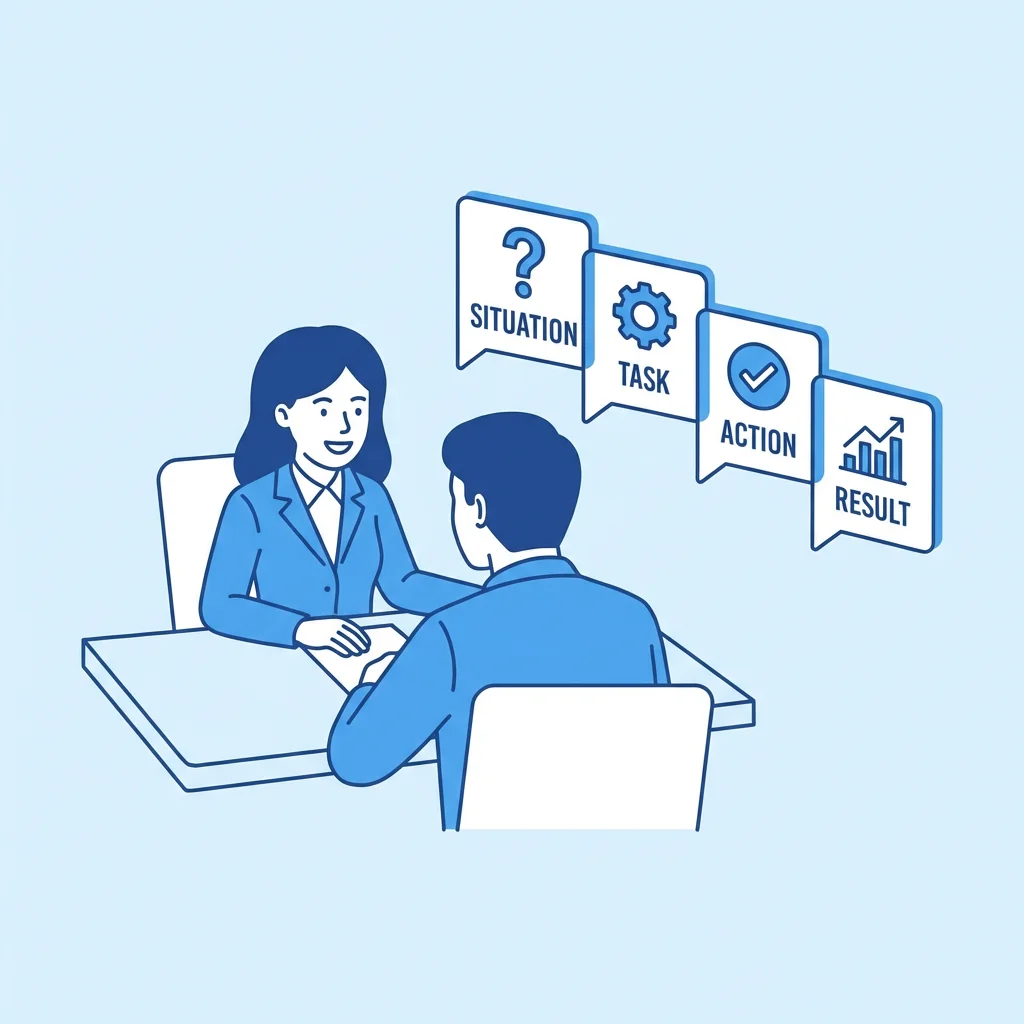
STAR is the right framework. The problem is that most people use it to tell a story — when the point is to make an argument.
The behavioral interview question is not asking "can you remember a relevant work experience?" It's asking: "do you have evidence that you can do the specific thing this role requires?" Those are different questions. The first one leads to meandering stories. The second one leads to tight, credible answers.
STAR works when you treat each letter as a constraint, not a prompt. Here's what each part should and shouldn't contain — and the 4 failure modes that make even good stories land flat.
4 ways STAR goes wrong — even with a good story
The Situation takes up 60% of the answer
You spend 90 seconds establishing context, 20 seconds on the task, 15 seconds on the action, and 5 seconds on the result. The interviewer learned everything about your former company and almost nothing about you. The Result is where you should spend the most time — not the Situation.
The Action is a list of things the team did
"We decided to..." / "The team worked on..." / "We all collaborated to..." The A in STAR is your action. Not the group's. Not the collective. What did YOU specifically do, decide, say, or build? Interviewers want to hire a person, not a team.
The Result has no number
"The project was successful" is not a result. "We shipped 2 weeks ahead of schedule and the feature drove a 14% increase in activation" is a result. Every STAR answer should end with a number or a specific outcome. If you don't have one, you're not done building the answer.
The story doesn't answer the actual question
The question was "tell me about a time you influenced without authority." You told a story about a project you led. Leading a team is not the same as influencing without one. Listen to the actual question and pick a story that directly demonstrates what they asked for.
What each letter actually means — with time allocation and examples
Situation
10–15% of your answerOne or two sentences. Set the scene. What were you working on, when, at what company or stage?
Strong
""Last year I was the PM on a checkout redesign at a Series B fintech — we were trying to reduce drop-off on the payment step.""
Weak
""So this was at my previous company, it was a startup, they did payments, it was around 2023, and the team was about 12 people across product, engineering, and design, and we had this initiative that had been in the backlog for a while...""
Task
10% of your answerWhat was your specific responsibility? What was the constraint or challenge you were personally accountable for?
Strong
""My job was to get us from 68% checkout completion to 80% in one quarter without touching the core payment infrastructure.""
Weak
""The team needed to improve checkout, and as the PM I was sort of responsible for coordinating everyone.""
Action
40–50% of your answerThis is the main event. Walk through what YOU specifically did — the decisions, the methods, the moments where you had to choose. Use first person singular.
Strong
""I started by pulling session recordings for every drop-off point. Found that 40% of abandonment happened at the address form. I ran 3 usability sessions in a week, identified the issue was form field count, not trust signals. Proposed a single-field autocomplete approach to engineering — they said it would take 6 weeks. I negotiated it down to 3 by cutting the address verification edge cases we were over-indexing on. We shipped it as an A/B test.""
Weak
""We worked together to analyze the data and then the team implemented some changes to the checkout flow.""
Result
25–30% of your answerWhat happened? Quantify it. Then — optionally but powerfully — add what you learned or what you'd do differently.
Strong
""Checkout completion went from 68% to 79% in 6 weeks. That translated to roughly $200K in monthly recovered revenue. The method — starting with session recordings before any assumption — is now the team's standard for any conversion problem.""
Weak
""The project went really well and the team was happy with the results.""
Build a story bank before the interview — not during
You need 5–7 strong stories prepared before any behavioral interview. Each story should be flexible enough to answer multiple question types with minor framing adjustments. Here are the 5 question types that cover roughly 80% of behavioral prompts:
"Tell me about a time you influenced without formal authority"
"Describe a situation where you had to push back on a stakeholder"
"Give me an example of when you had to deliver difficult feedback"
"Tell me about a time you had to move fast with incomplete information"
"Describe a project where things didn't go as planned"
For each story in your bank: write the Result first. Then build backward. If you can't write a specific, quantified Result, the story isn't ready yet. This forces you to find examples where something actually happened — not just examples where you were involved in something that happened.
The highest-performing interview candidates we've seen don't necessarily have better stories than average. They have the same 5–6 stories as everyone else — they've just practiced them enough that they know exactly which one to use for which question, and they can deliver the Action part with specificity and confidence instead of searching for details in real time. Practice doesn't make the stories better. It makes the delivery better. And delivery is what the interviewer actually experiences.
Career Capybara's interview prep helps you build and refine your story bank before you're under pressure. Try it free.
STAR is the frame. Your specific action is the painting.
Get the ratio right. Lead with what you did, not where you worked.