Stop giving status updates in meetings. Automate them instead.
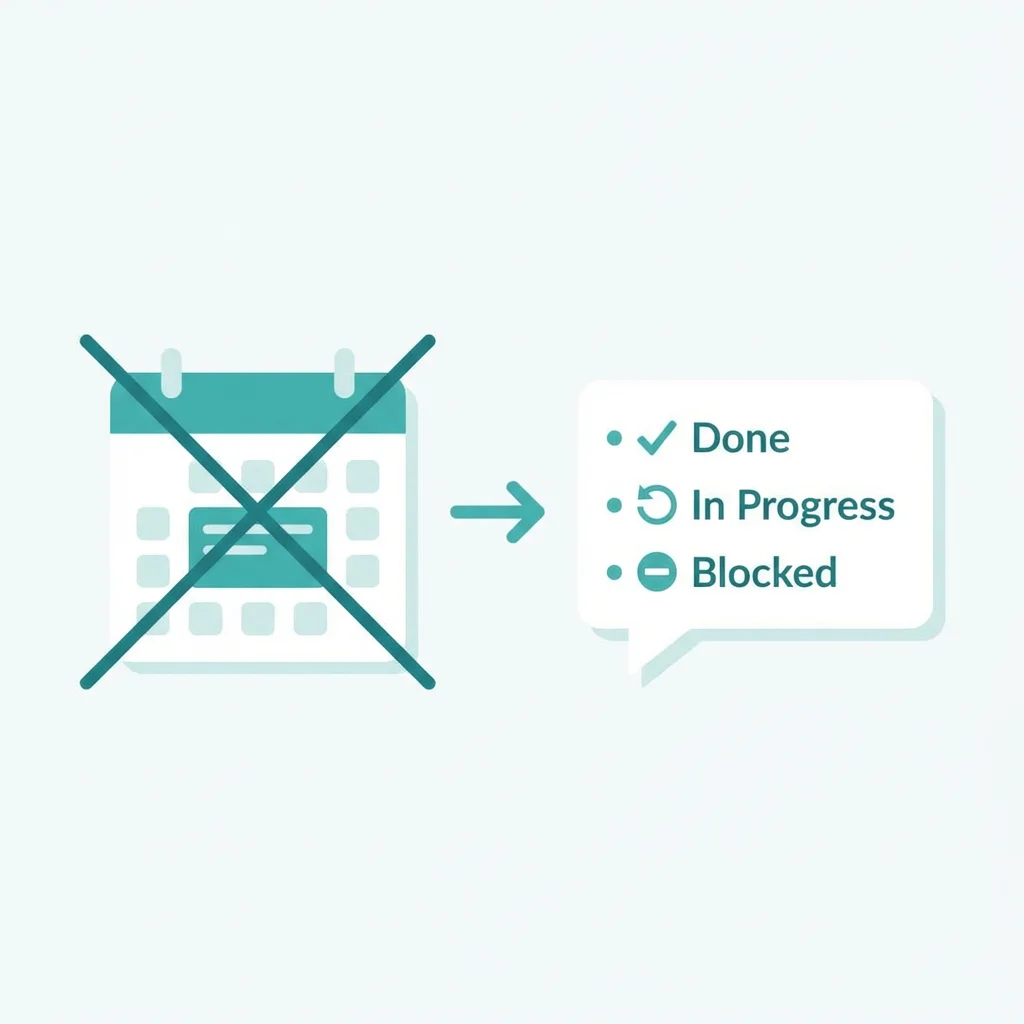
The weekly status meeting exists because your manager doesn't know what's happening. The solution is not more meetings — it's making the information available without requiring one.
Status updates are information transfer. Information transfer is one of the easiest things to automate — or at least to structure in a way that doesn't require 8 people on a Zoom call every Tuesday at 10am.
Here's the full system: why status meetings fail, four async formats that replace them (with exact templates and tools), and how to handle the manager who insists on the meeting anyway.
Why status meetings are structurally broken
They happen on a schedule, not when information is ready
A Friday status meeting reports on a week that mostly happened Tuesday through Thursday. By the time information surfaces, it's already been processed and acted on — or it's stale. Real-time async updates surface blockers when they happen, not a week later.
They force everyone to perform readiness simultaneously
Status meetings require every stakeholder to be available at the same time, even when they have different information needs and different time zones. The meeting serves the schedule, not the information.
Important things get omitted because the format discourages detail
"How's the project going?" in a meeting gets a summary. A written async update can include the nuance, the risk, the dependency — because the writer has time to think and the reader has time to read.
4 async formats that replace the status meeting
These aren't hypothetical. Each of these is actively used by distributed teams that have eliminated their weekly status calls. Pick the one that fits your team's workflow — or combine them.
The Weekly Slack Bot Update
Use Slack's scheduled messages or a tool like Geekbot / Standuply to send a standard prompt to the team channel every Monday morning.
Template
""What did you ship last week? What are you focused on this week? Any blockers I should know about?""
Why it works
Creates a searchable, async record of team progress without a single meeting. Manager reads it Monday morning instead of running a status call.
The Friday 3-Bullet Email
Every Friday before you log off, send your manager 3 bullets: done, doing, blocked. Takes 4 minutes. Replaces the need for a check-in meeting.
Template
""✅ Done: [X]. 🔄 In progress: [Y — will complete by Tuesday]. 🚧 Blocked: [Z — need your input on vendor decision by EOD Monday].""
Why it works
Your manager goes into the weekend with full situational awareness. You go in without a Monday morning status call looming.
The Loom Async Video
For complex updates — demos, design reviews, technical walkthroughs — record a 3–5 minute Loom instead of scheduling a sync meeting.
Template
"Screen + voice. Show the thing, explain the decision, state what you need. Send with: "Watch at 1.5x — I'll leave the meeting slot open in case you have questions after.""
Why it works
73% of Loom's own research shows async video decisions are made faster than their sync equivalents. You also get a permanent record.
The Project Dashboard
A shared Notion page / Linear project / Asana board that is always current. Stakeholders self-serve instead of asking for updates.
Template
"Columns: In Progress, Blocked, Done This Week, Up Next. Owner updates it daily. Stakeholders check it before asking."
Why it works
The "quick question" message that generates a 20-minute meeting becomes a 20-second page view.
The 3 objections — and what to say
""My manager won't trust async — they want to see people in meetings.""
Start with a parallel experiment: keep the meeting, but also send the Friday update. After 4 weeks of your manager reading your updates and having fewer questions at the meeting, propose shortening the meeting to 15 minutes. Then to biweekly. The trust builds from the track record, not from the proposal.
""People won't actually read async updates.""
This is a format problem. If the update is a wall of text, it won't get read. If it's three bullets with a clear subject line and a bold sentence for the blocker — it takes 30 seconds to read. Make it easy to consume and people consume it.
""Some things need real-time discussion.""
Yes. Genuine ambiguity, high-stakes decisions, and real-time collaboration all benefit from sync. The goal isn't to eliminate meetings — it's to eliminate the subset of meetings that exist only because there was no alternative way to transfer information. That subset is surprisingly large.
The unexpected benefit: it builds more trust than the meeting does
This is the counterintuitive part. Managers who require status meetings are often doing so because they don't feel like they have visibility. A well-designed async update system gives them more visibility — not less — because it's searchable, timestamped, and consistently formatted.
When a manager can check a Notion page or read 3 bullets in Slack and immediately understand the state of a project, they no longer need the meeting to feel informed. The meeting was compensating for an information gap. Fix the gap and the meeting often disappears on its own.
One thing we see consistently: the people who are most proactive about async communication — who send the Friday update without being asked, who post the project status before the manager checks — are the ones who get described as "low maintenance" by their managers. Low maintenance is a compliment in a busy organization. It means: I can trust this person to keep me informed without me having to chase them. That trust is worth more than almost anything else you can build in a working relationship.
Replace the status meeting with a system. Keep the trust.
4 minutes on Friday. Searchable forever. No Tuesday meeting required.