The 3 habits that actually make you more productive. None of them involve a new app.
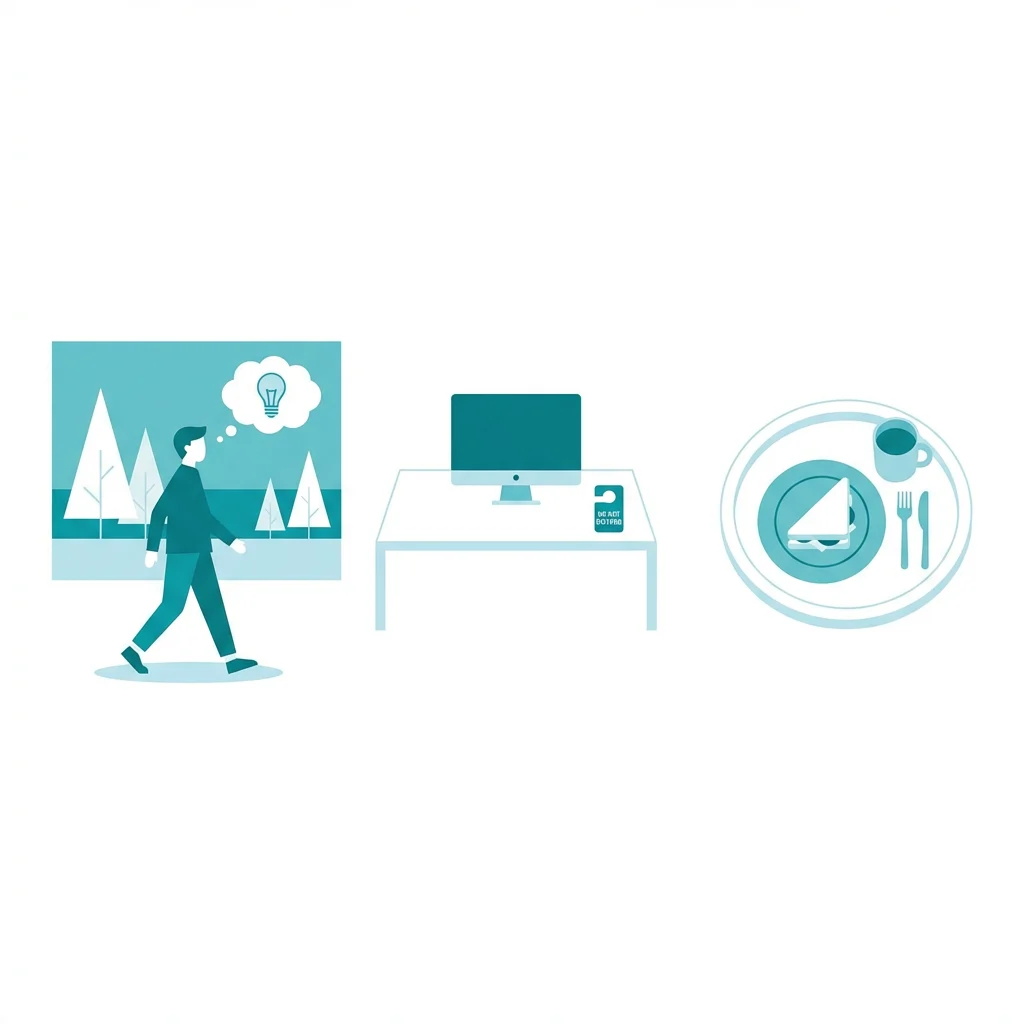
The productivity industry has convinced us that productivity is a tools problem. More often, it's a biology problem.
Your brain has a fixed daily supply of high-quality attention. You can spend it intentionally — on the work that actually matters, in conditions that let you do it well — or you can spend it in meetings, in email, in the ambient noise of a fragmented workday. The output is very different.
Three habits reliably make a material difference to how much quality work you produce per day. They're free, backed by solid research, and take no special equipment. Most people know about them and still don't do them consistently — which is why they remain differentiating when you actually commit.
1. The daily walk
Stanford researchers found that creative output increased by 81% during walking — and the effect persisted for up to 30 minutes after returning to a desk.
Walking increases cerebral blood flow and triggers a shift from focused to diffuse thinking — the mode where pattern recognition, creative connection, and problem-solving happen. You can't force diffuse thinking at a desk. Movement reliably induces it.
How to implement it
Schedule it like a meeting — same time daily, on the calendar
No phone calls, no podcasts for the first 10 minutes — let your brain wander
Keep a notes app or a small notebook for the ideas that show up (they will)
If you have a complex problem you're stuck on: write it down before the walk, don't think about it actively, see what surfaces
Common mistake
Turning the walk into a phone call. You get the physical benefit but none of the cognitive one. The value is in the unstructured mental space.
2. Protecting lunch
A University of Illinois study found that brief mental breaks dramatically improved sustained attention — and employees who took lunch away from their desks reported 30% lower afternoon cognitive fatigue.
Decision fatigue is real and well-documented. By noon, you've already made hundreds of micro-decisions. The brain's prefrontal cortex — responsible for judgment, focus, and executive function — depletes with use. An actual break rebuilds it. Eating at your desk while checking email is not a break.
How to implement it
Leave the desk. Even for 20 minutes. Even if you eat in a conference room.
No work conversations during lunch — this is harder to enforce in some cultures, but worth the social awkwardness
Eat something real. Cognitive performance is measurably affected by blood sugar stability.
Use it for the walk if you haven't done it yet — the combination compounds
Common mistake
"I'll eat at my desk and save the time." You're not saving time — you're borrowing it from your afternoon at a high interest rate.
3. The daily focus block
Cal Newport's research, corroborated by multiple organizational psychology studies, shows that 90–120 minutes of uninterrupted deep work produces more high-quality output than 4–5 hours of fragmented work time.
Deep work requires an on-ramp. Context-switching costs 15–20 minutes of re-engagement time per interruption. A 90-minute block with zero interruptions isn't just 90 minutes of work — it's 90 minutes of high-quality work that's qualitatively different from what you produce in the gaps between meetings.
How to implement it
Pick the time when your cognitive performance peaks — for most people, this is 9–11am or 2–4pm
Block it on your calendar as a recurring appointment with yourself
Phone on silent, Slack on Do Not Disturb, email closed
Have exactly one task written down before you start — not a list
Build to 90 minutes. Start with 45 if that's more realistic right now.
Common mistake
Starting the block without knowing what you're working on. Decision-making at the start of a focus block burns the focus. Decide the night before.
What happens when you stack all three
Walk in the morning to clear your head and surface ideas. Protect 90 minutes of focused work before the first meeting. Take a real lunch break to reset. The afternoon is still fragmented — most people's are — but the morning output is high quality and the afternoon cognitive depletion is significantly less severe.
The research on this combination isn't just theoretical. Microsoft's Work Trend Index found that employees who maintained consistent daily movement, protected lunch, and used scheduled focus blocks reported 40% fewer burnout symptoms and 20% higher job satisfaction than those who didn't — independent of workload, seniority, or industry.
One thing that comes up in career coaching conversations consistently: the people who feel most in control of their work — not necessarily the most senior, not always the highest earners — are almost always the ones who've built these three habits. Not because the habits create control. Because the habits create the conditions for clear thinking, and clear thinking creates a sense of agency. It compounds.
And when your thinking is clearer and your energy is more consistent, the career moves that matter — applications, interview prep, strategic decisions — get done with better judgment and less friction. Career Capybara is built for exactly that kind of intentional, focused job seeker. Try it free.
Walk. Protect lunch. Focus block. Repeat.
Three habits, no apps, no subscriptions. Just the biology working for you instead of against you.